
Today we are proud to share a story of research that has impact, contributing to telling people’s stories and improving their conditions.
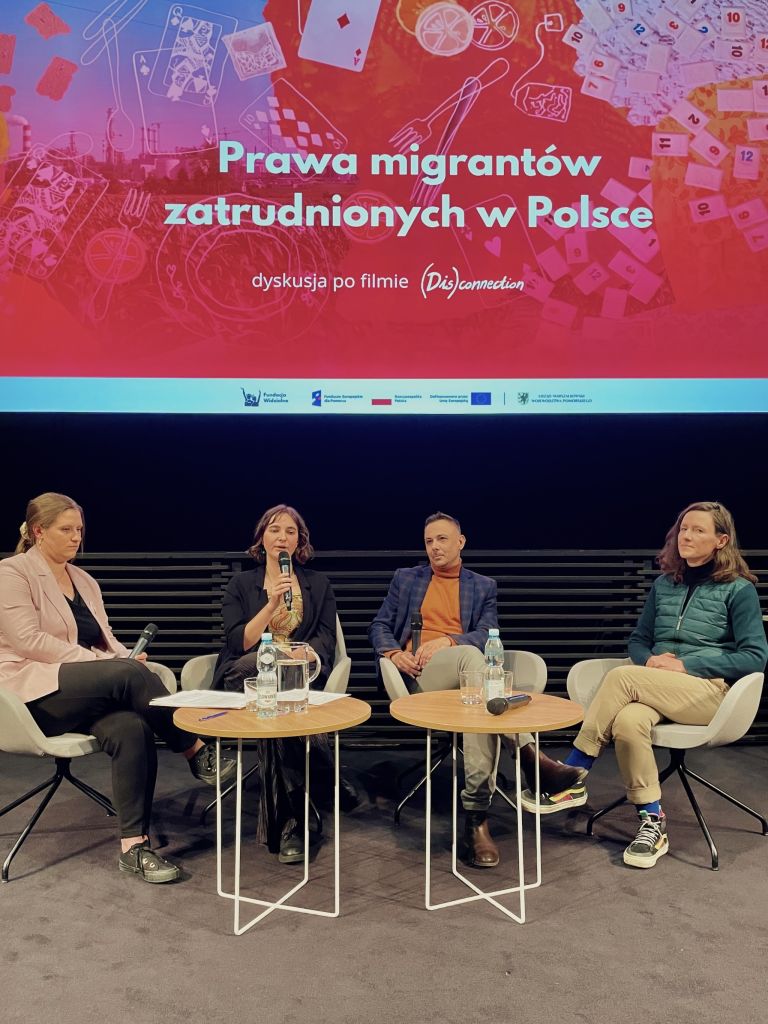
Our MA Visual Anthropology alumna Marianna Łoboda was invited to screen her graduation film (Dis)connnection in Gdańsk, at the Second World War Museum. The screening was followed by a discussion with the filmmaker, a national labour inspector, and a representative from the Polish Migration Forum (you can watch it here, in Polish). Marianna has also been invited to screen the film in other Polish cities (Warsaw, Wrocław, and Kraków).
(Dis)connnection is based on Marianna’s final MA project, which brought to light the fact that workers in a Polish petrochemical investment project were not receiving their salaries. During her fieldwork, Marianna took several steps to address the situation. She contacted four journalists, which resulted in articles and radio coverage about the unpaid salaries. She filed official complaints with the National Labour Inspectorate and the Polish Ombudsman, contacted the Ministry of State Assets, and reached out to politicians who later shared the story of migrant workers not being paid for months. At the same time, she prepared informational brochures explaining the rights of migrants employed in Poland. Many of them took these brochures for themselves and their friends, and after the project ended, some workers continued to consult her when considering actions such as striking.
Marianna also contacted the company whose subcontractors were withholding salaries and spoke with them directly. Later, she invited both the company and the Labour Inspectorate to the Gdansk screening of her film. One of the labour inspectors responsible for investigating the issue attended, while the company did not. However, Marianna obtained documentation from the company confirming that they had changed their agreements with subcontractors so that salaries should be paid on time. Around the same time, migrants informed her that they had in fact received all their outstanding salaries. As of 3 February, the National Labour Inspector has also imposed financial penalties on the company.
After the screening, a labour inspector who attended shared that some changes would be made in how the company is inspected, as they had recognised that previous methods of addressing the abuse were not effective. Marianna admits that she cannot say how far these declarations will be implemented or whether any improvements will last in the long term, but she hopes that increasing the visibility of the people in the camp and of this issue has helped, even if only to a small extent.
Watch the film and the photo essay on our showcase page